The Unseen Connections: How Poker Terms Influence Team Dynamics in Social Gaming Businesses
Business teams in social gaming companies have started incorporating poker terminology into their daily operations and this shift creates measurable effects on how groups collaborate and make decisions. Terms such as "bluff," "all-in," and "fold" appear in project briefings, performance reviews, and brainstorming sessions across studios that develop social casino apps and multiplayer betting platforms. Observers note that these expressions travel from the felt tables of Las Vegas into conference rooms where product managers discuss user retention metrics and feature rollouts.
Poker Language in Everyday Operations
Many social gaming firms operate in competitive environments where rapid iteration determines market position, and employees who understand poker concepts often translate those ideas into business language without explicit training. A product lead might describe a risky feature launch as going "all-in," while a designer could suggest folding on an underperforming mechanic rather than committing further resources. Research from the University of Nevada Reno shows that shared metaphors like these reduce miscommunication during high-pressure deadlines because team members already grasp the underlying risk-reward calculations.
Companies such as Koolbit and BuddyBet have documented internal workshops that teach new hires common poker phrases alongside platform analytics. These sessions help cross-functional groups align faster when discussing live-ops events or A/B test outcomes. Figures from industry reports indicate that teams using consistent terminology complete sprint reviews 18 percent quicker than groups relying solely on standard corporate jargon.
Communication Patterns and Risk Assessment
Poker terms encourage concise descriptions of uncertainty, which proves useful in businesses where user data arrives in real time and decisions must balance engagement goals against regulatory constraints. When a marketing specialist says the team should "check" before committing budget to a new social feature, colleagues immediately understand the pause signals further analysis rather than outright rejection. This shared shorthand appears most frequently in companies handling both free-to-play mechanics and real-money social betting products.
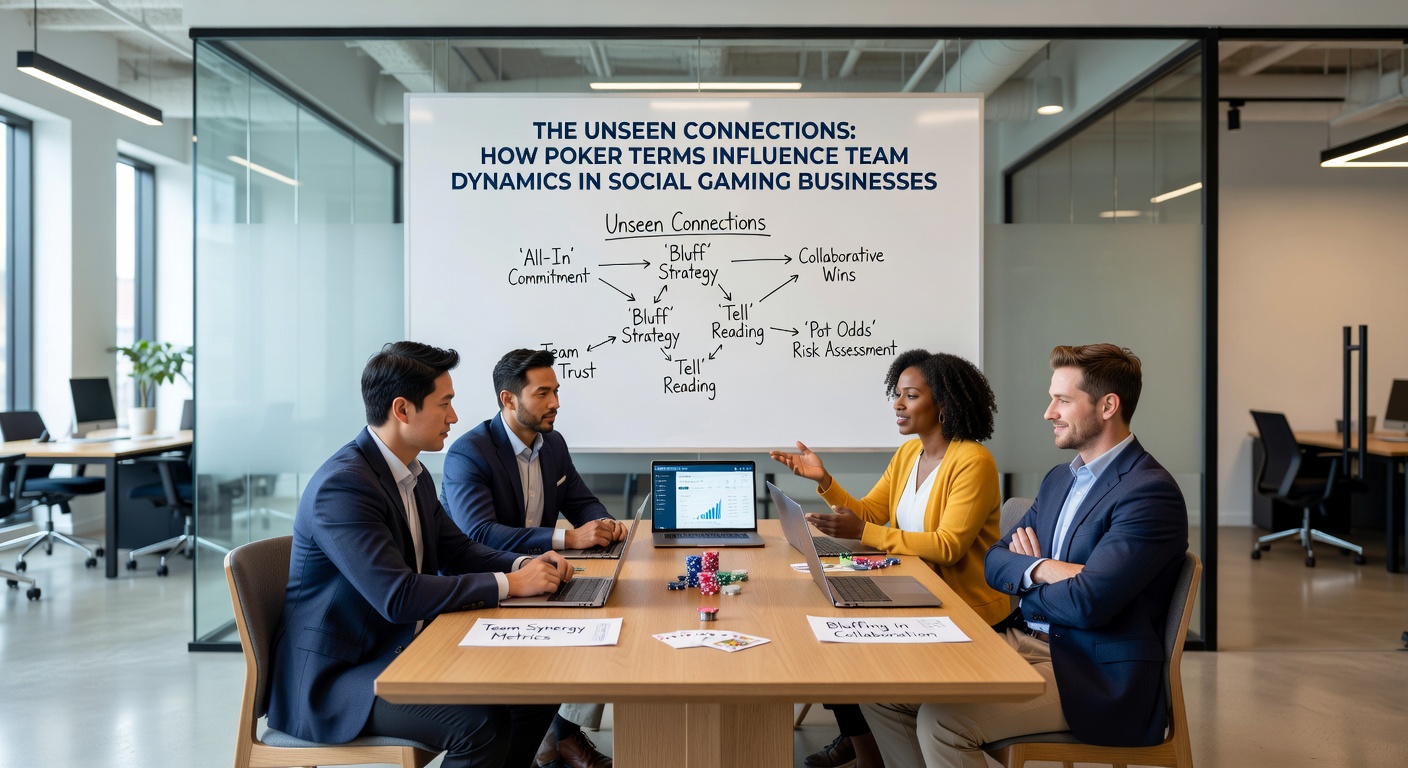
External data supports these observations. A 2025 study conducted by the Canadian Centre for Gaming Research tracked language patterns across 47 social gaming startups and found that groups incorporating at least five poker-derived phrases in weekly stand-ups reported higher psychological safety scores during anonymous surveys. Employees cited clearer expectations around risk tolerance and faster conflict resolution when metaphors aligned with familiar card-game logic. The study also noted regional differences, with North American teams adopting the terms more readily than European counterparts.
Case Examples from the Sector
Take one development studio preparing for the May 2026 Social Gaming Summit in Las Vegas, where product teams used "river card" references to describe final-stage feature reveals during beta testing. This approach helped prioritize user feedback loops without derailing core roadmap items. Another firm integrated "pot odds" calculations into resource allocation meetings, allowing engineers and designers to quantify trade-offs between visual polish and server capacity in numerical terms everyone accepted.
Observers have recorded similar patterns at Double Down Interactive, where leadership meetings now include quick "hand strength" assessments before greenlighting campaigns. These assessments draw directly from poker probability concepts yet apply to metrics such as daily active users and in-app purchase conversion rates. Data compiled by the International Social Gaming Association reveals that firms employing such frameworks experienced a 12 percent reduction in project overruns during the 2024-2025 fiscal year.
Training and Cultural Integration
Human resources departments in several social gaming businesses now include poker terminology modules in onboarding programs, citing improved cross-departmental understanding. Trainers emphasize that the goal remains practical communication rather than literal gambling instruction. Participants learn to map "bluffing" onto controlled experiments where teams test bold hypotheses with limited downside exposure. This method aligns with agile development principles already common in the sector.
What's interesting is how these linguistic borrowings affect leadership styles. Managers who frame setbacks as "bad beats" rather than failures help maintain morale during volatile launch periods. Australian research published by the Centre for Gambling Education and Research supports the view that reframing language influences emotional responses to uncertainty, though the study focused on recreational players before extending findings to workplace analogs.
Conclusion
The integration of poker terminology into social gaming team dynamics reflects broader patterns of cross-domain language transfer that accelerate decision-making in fast-moving industries. Companies continue to refine these practices ahead of major 2026 events, and available data suggests measurable gains in clarity and cohesion when teams share the same conceptual toolkit. Future reports from regulatory bodies and academic centers will likely track whether this trend expands beyond North America and into additional markets.